Bank of America · Erica
Designing conversational routing at scale.
I led the design of Erica’s Contact Us experience, a conversational routing system that understood customer needs, offered self-service options, and connected people to the right support.
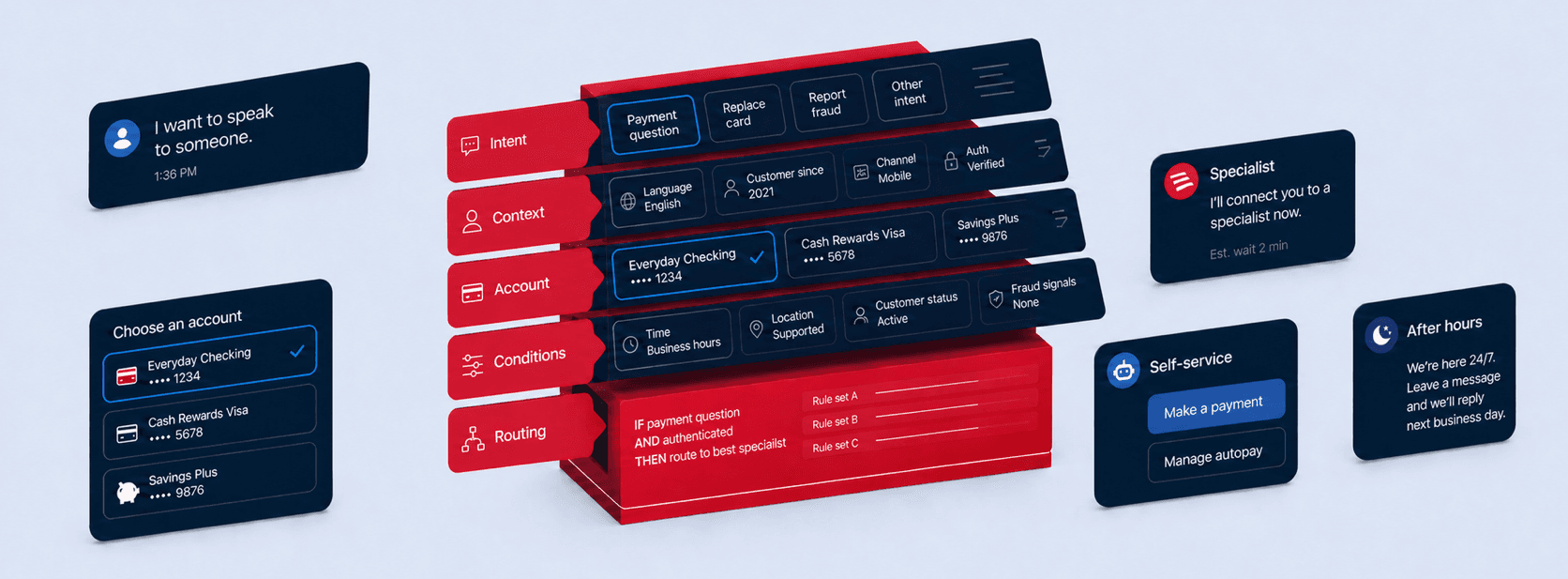
I led the design of Erica’s Contact Us experience, a conversational routing system that understood customer needs, offered self-service options, and connected people to the right support.
48%
of all Bank of America mobile calls
routed through Erica
1.4M+
call deflections annually
resolved without an agent
20%
reduction in mobile calls
with no negative impact to satisfaction
The opportunity
Creating a better path to customer support.
Customers contacted Bank of America for hundreds of different reasons, but reaching the right support often depended on navigating predefined menus or being transferred between agents.
That created a significant business opportunity. Every unnecessary call and transfer increased operating costs, while customers were left repeating information they had already provided.
By introducing Erica at the beginning of the experience, we could use natural language processing to better understand why a customer needed help, gather important context from the conversation, and create a more direct path to the right support.
Traditional support
Erica routing
The system
Turning natural language into routing decisions.
The challenge was not designing a single contact flow. We needed a system that could support more than 50 types of customer needs across accounts, cards, payments, transfers, fraud, lending, investments, and other areas of the bank.
I was the sole conversation designer within the product pod and owned the experience over several years. I established a shared framework that translated natural-language requests into structured call topics, each containing the information and logic required to determine what should happen next.
Depending on the request, Erica could route the customer directly, ask for additional information, identify a relevant product or account, present a self-service capability, or continue into a specialized flow.
This modular model allowed new topics to be introduced without redesigning the core system each time.
Natural-language request
Recognized call topic
Required context
Which type of account?
Appropriate route
The same framework supports every call topic
The experience
Designing for ambiguity without creating another phone tree.
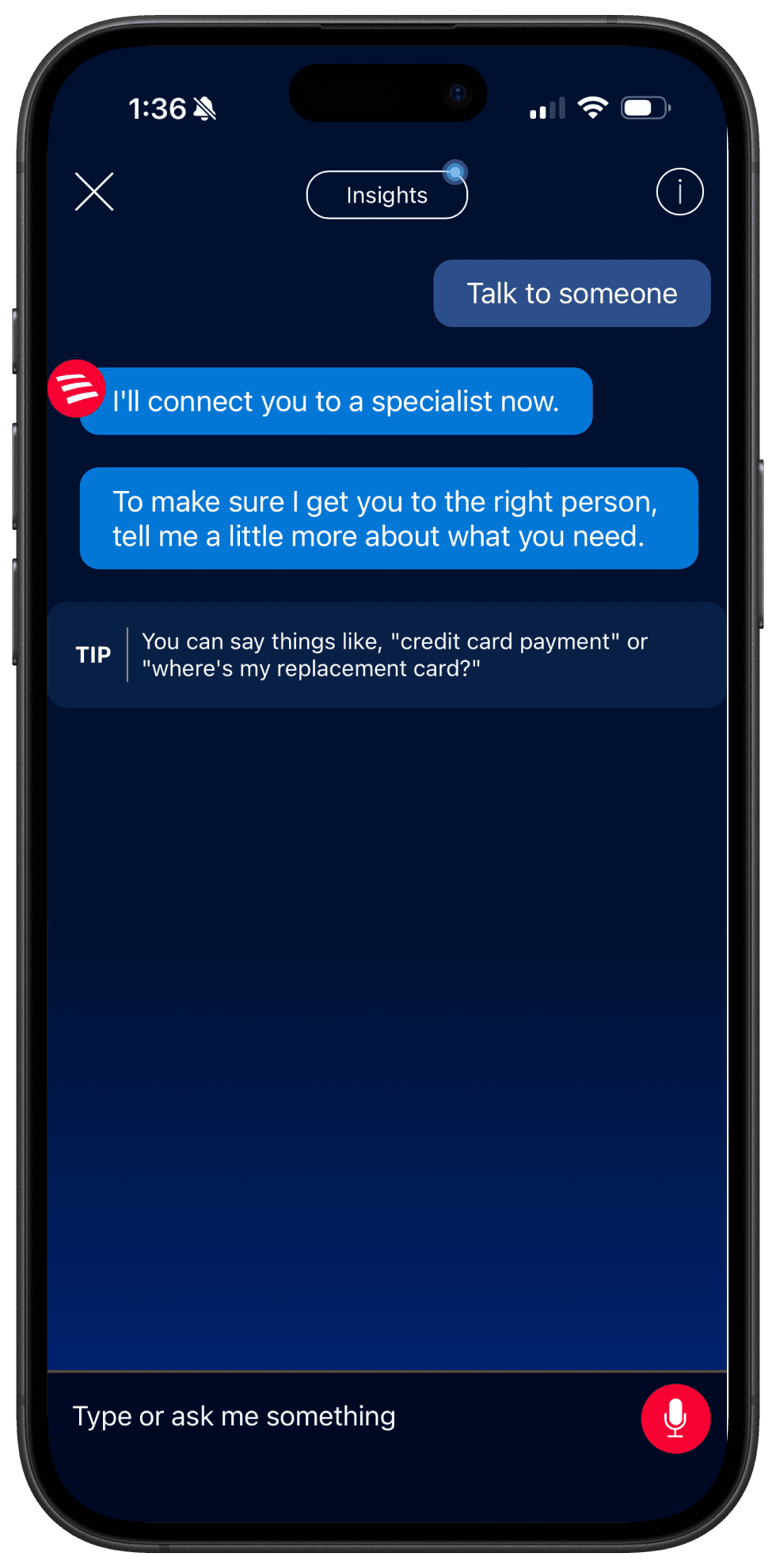
Customers rarely described their needs using the language of the bank's internal routing system. Some requests were specific, while others provided little more than “I need to speak with someone.”
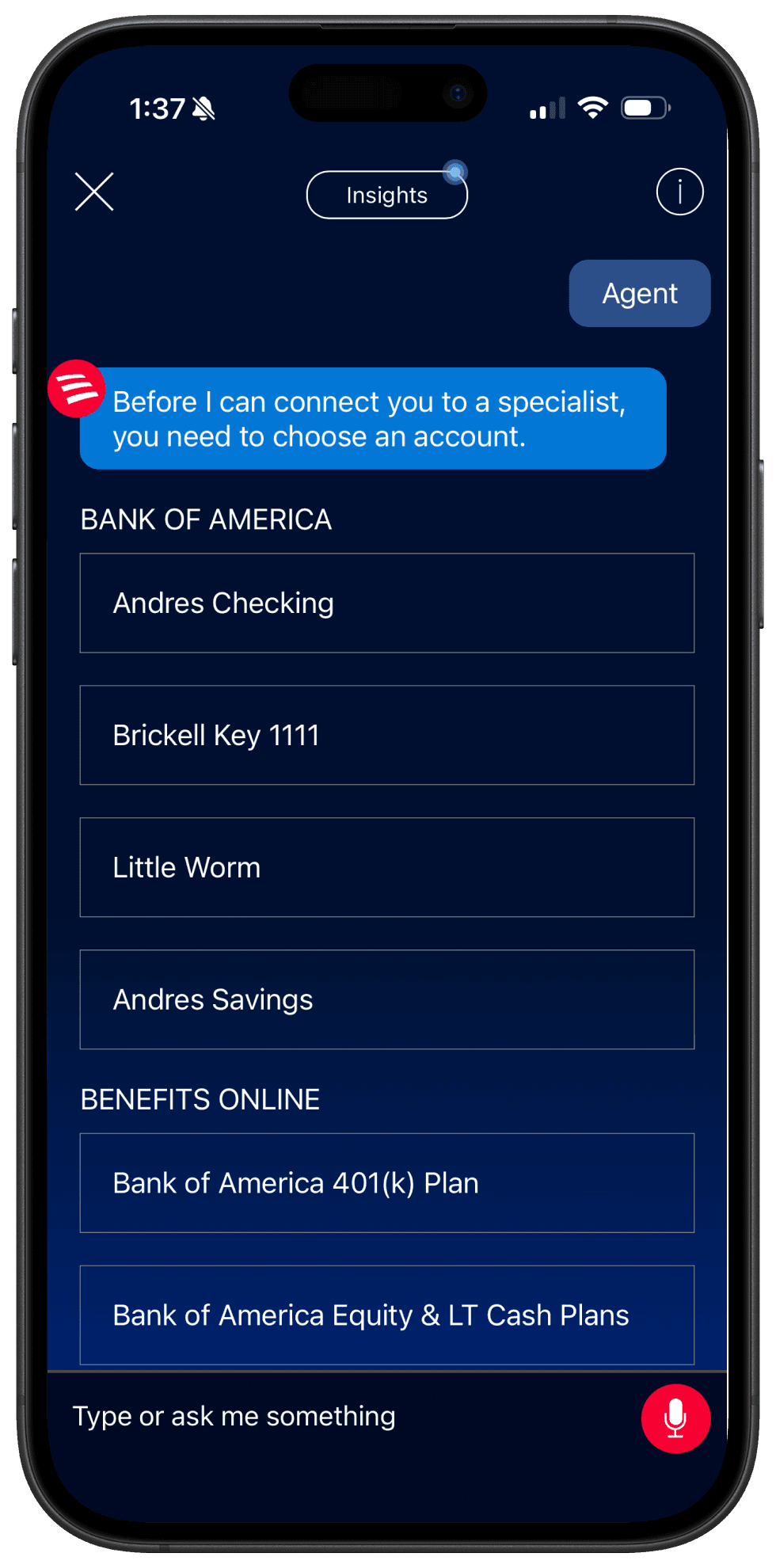
I designed progressive clarification patterns that allowed Erica to gather only the information required to make the next routing decision. A request might require identifying an account type, determining whether the customer was asking about a new or existing product, or selecting a specific account or card.
When requests remained vague, Erica could ask for more detail, offer examples of what the customer might say, or suggest relevant options based on available context.
The goal was to improve routing confidence without forcing customers through a long sequence of questions or trapping them in a clarification loop.
Clarify the request
Erica asks the customer to describe what they need in their own words.
Gather required context
Erica collects the account information required to complete the route.
The expansion
Resolving customer needs before the call.
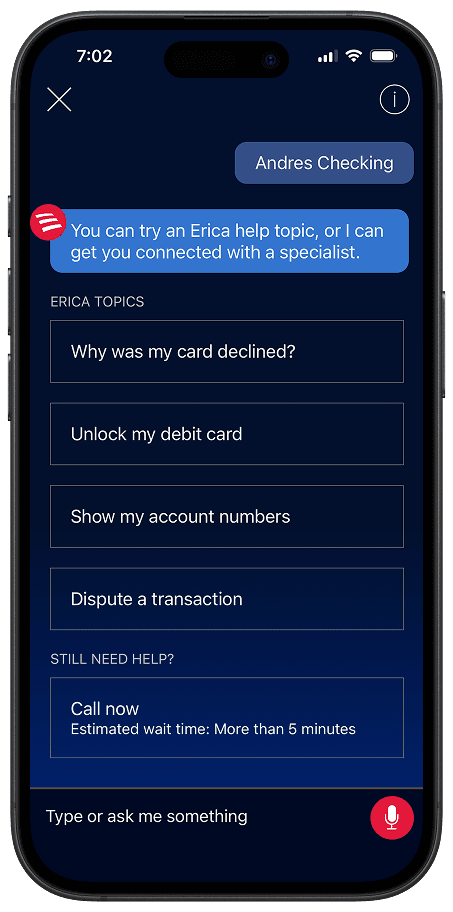
As Erica's capabilities grew, the Contact Us experience evolved beyond routing. Before connecting customers with an agent, Erica could surface relevant self-service capabilities based on what they were trying to accomplish.
Customers could still continue with the call, but they could also choose to complete tasks such as unlocking a card, reviewing a transaction, or finding account information directly within Erica.
I designed the hierarchy and interaction patterns so these alternatives felt helpful rather than obstructive. Self-service options were presented as something Erica could handle immediately, while access to human support remained clear.
The same routing foundation later expanded to support additional channels, including live-agent chat, creating greater consistency in how customer intent and context moved between experiences.
Designing for scale
Accounting for the realities of customer support.
The appropriate experience depended on more than the customer's intent. It also needed to respond to operational conditions across the bank's support network.
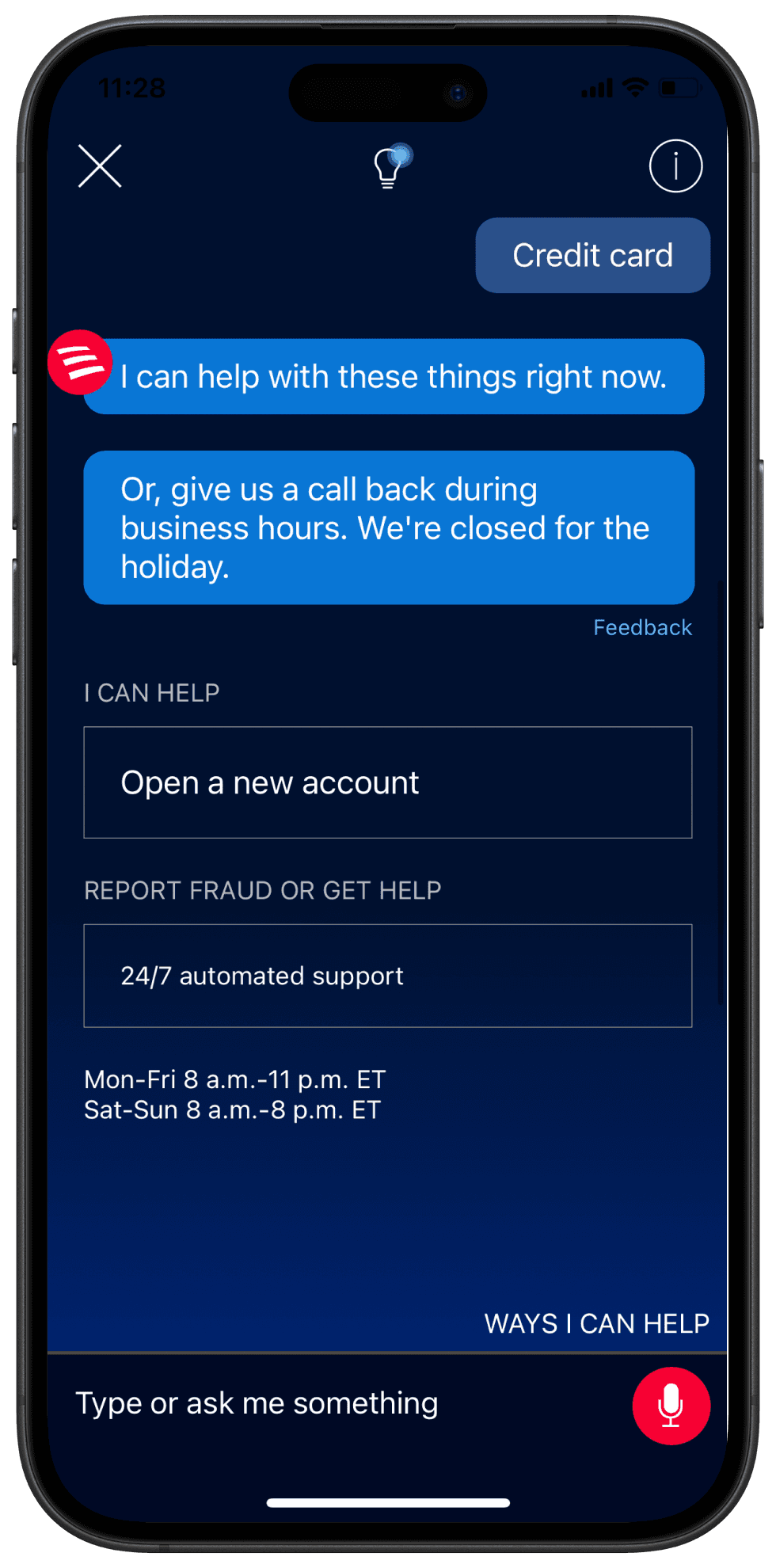
The system accounted for whether a call center was open, estimated wait times, holidays, unexpected closures, specialized routing requirements, and the availability of automated or 24-hour support.
When the preferred destination was unavailable, Erica could explain the situation, provide business hours, offer another support path, or surface relevant self-service alternatives.
Treating these conditions as part of the shared framework allowed the experience to remain consistent as new call topics, product areas, and destinations were introduced.
Resolve without a call
Relevant Erica capabilities appear before the customer connects to an agent.
Adapt to availability
When support is closed, Erica provides useful alternatives and clear expectations.
Impact
Improving support while reducing call volume.
The redesigned Contact Us experience became a significant entry point for mobile customer support, ultimately routing 48% of all Bank of America mobile calls through Erica.
By helping customers reach the correct destination and offering self-service when appropriate, the experience produced more than 1.4 million call deflections annually and contributed to a 20% reduction in mobile call volume.
Those results were achieved without a negative effect on customer satisfaction, demonstrating that the experience could reduce operating costs while also creating a clearer and more useful path to support.
The experience ultimately became so successful that Bank of America replaced the traditional Contact Us page in its mobile app with an entry point into Erica's conversational flow. What began as an alternative way to reach support became the primary model for accessing it.
Reflection
Designing a system that could grow without starting over.
One of the most consequential decisions was treating Contact Us as a modular system from the beginning rather than designing a collection of independent routing flows.
Call topics shared a common framework while retaining their own requirements, clarification logic, self-service options, and destinations. That separation allowed individual parts of the experience to evolve without requiring the underlying system to be redesigned.
The value of that decision became clearer over time. The experience expanded to support more than 50 call types, increasingly sophisticated self-service capabilities, changing operational conditions, and new channels such as live-agent chat—while preserving the foundation established in the original design.
The project reinforced the value of designing beyond the immediate requirements. By anticipating change and creating a framework that could adapt, we were able to support years of growth without repeatedly rebuilding the experience. Erica did not need to resolve every request itself to provide value, but it did need a durable system for understanding customer needs and connecting them to the best available outcome.