Wells Fargo · Fargo
Designing Fargo’s daily AI financial briefing.
I led the design of Daily Digest, a generative AI experience that analyzed a customer’s financial activity and transformed it into a concise, personalized daily summary.
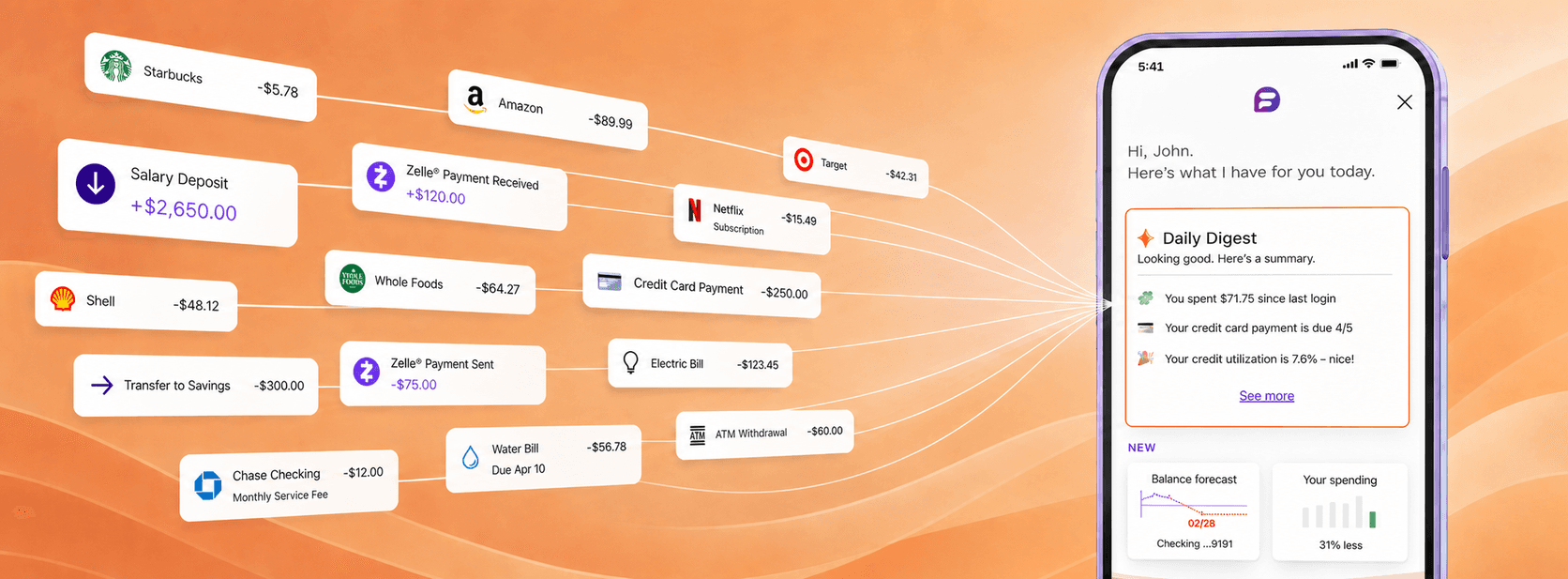
I led the design of Daily Digest, a generative AI experience that analyzed a customer’s financial activity and transformed it into a concise, personalized daily summary.
The opportunity
Giving customers a reason to return every day.
Fargo had become a trusted assistant for answering financial questions, but most interactions still relied on customers initiating the conversation. That created an opportunity to rethink how AI could provide value beyond simply responding to requests.
Rather than waiting for a specific financial event, we explored how Fargo could proactively create value every day by interpreting a customer's financial activity and delivering a personalized summary of what mattered most.
The challenge wasn't simply generating text. It was determining which information deserved attention, how to prioritize it, and how to present it in a way customers could understand in seconds.
A personalized reason to return every day.
Monday
Start the week with clarity
See what’s important now so you can plan the days ahead.
Tuesday
Track progress and trends
Understand how your money is moving through the week.
Wednesday
Stay focused on your goals
Get encouragement and insights that help you keep building.
Thursday
Plan ahead with confidence
Know what’s coming so you can take action before it’s due.
Friday
Finish strong and feel in control
Review the week and move into the weekend with peace of mind.
Designing the intelligence
Designing how the AI reasons.
Through the implementation of generative AI, Daily Digest could produce a wide range of observations and conclusions based on a customer's financial activity. The challenge wasn't generating more information—it was determining which insights would actually be useful, relevant, and worth a customer's attention.
I worked closely with product and technology partners to define the framework the LLM would follow when interpreting a customer's financial activity. Together, we established how different events should be evaluated, how topics should be prioritized, and when the experience should educate, encourage, warn, or celebrate.
One of the biggest challenges was that the AI often produced observations that were technically correct but added very little value. Many responses simply restated obvious information or highlighted details that weren't particularly interesting. Through continuous experimentation and refinement, we trained the system to identify patterns, changes, and opportunities that required meaningful analysis rather than simply describing what had already happened.
Rather than relying on a single prompt, we developed a structured decision model that combined transaction analysis, categorization, prioritization, topic selection, and content generation.
Customer financial activity
Transactions, balances, payments, behavior, and context.
Pattern detection
Identify meaningful signals, changes, and financial trends.
Design decisions
Every potential insight is evaluated through a shared reasoning framework before it reaches the customer.
Relevance
Timing
Customer value
Actionability
Trust
Variety
Daily Digest
The most relevant, timely, and valuable insights for today.
The methodology
Designing through experimentation.
Developing Daily Digest was an iterative process centered on experimentation. We explored different prompt structures, reasoning models, ranking strategies, and content formats to understand how the AI should interpret financial activity and communicate it back to customers.
Each iteration was evaluated for clarity, relevance, tone, personalization, explanation depth, and actionability. We also tested which financial topics customers found valuable enough to receive daily and which were better suited to less frequent communication.
Customer feedback played an important role throughout the process. It helped shape both the content itself and the underlying prioritization system, ensuring the experience surfaced information that felt genuinely useful rather than simply accurate.
Over time, those experiments evolved into a structured framework that guided how the system selected, prioritized, and presented information. The objective wasn't to generate more content—it was to consistently deliver a small number of insights that felt timely, relevant, and worthwhile.
Topic testing
What customers wanted to receive.
Upcoming transactions
4.3
Subscriptions
4.1
Balance
4.1
Recurring charges
4.0
Recent transactions
4.0
Budgeting
3.9
Fee avoidance
3.9
Credit health
3.7
Average customer interest score out of 5.
Customer evaluation
More than accuracy.
Generated content was assessed across the qualities that determined whether it felt worth returning for.
Relevance
Interest
Clarity
Actionability
Daily value
Framework refinement
Every test shaped the next.
Findings from prompt exploration and customer feedback were translated into repeatable design rules that guided how Daily Digest selected and presented information.
01
Generate
Explore different topics, tones, and formats.
02
Evaluate
Review outputs against customer and product needs.
03
Learn
Identify the patterns customers consistently value.
04
Refine
Update prompts, weighting, and selection rules.
The experience
Making AI-generated summaries easy to consume.
Once the intelligence was established, the interface needed to make the results immediately understandable.
The experience supported different levels of engagement. Customers could scan a concise summary, expand individual points for more context, or reveal additional insights when they wanted a more complete picture of their financial activity.
This progressive structure allowed Daily Digest to remain lightweight while still giving customers access to the reasoning and financial context behind its recommendations.
Structured UI, consistent hierarchy, and concise generated language helped the experience feel dependable rather than like an open-ended AI response.
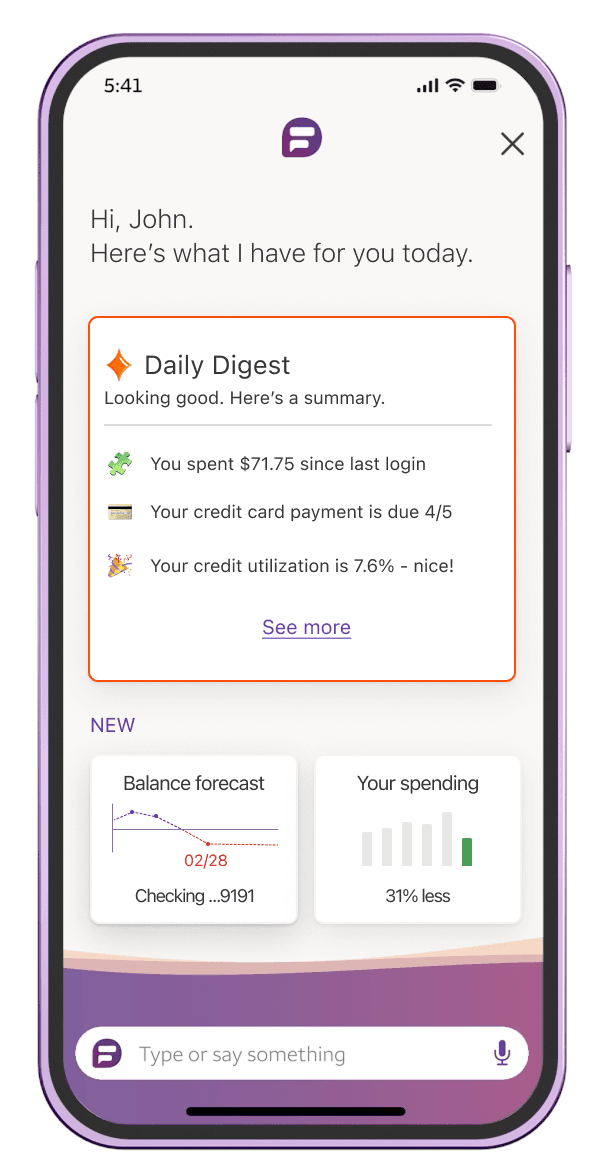
Concise daily summary
The most important insights are immediately visible in the default view.
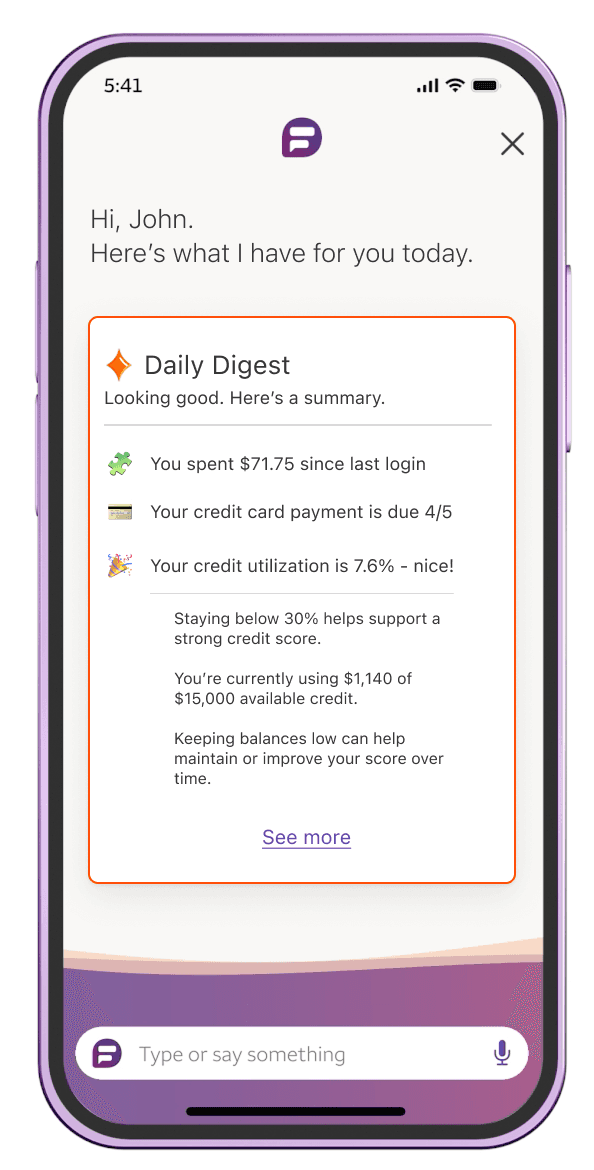
Additional context
Customers can expand the digest to better understand an individual insight.
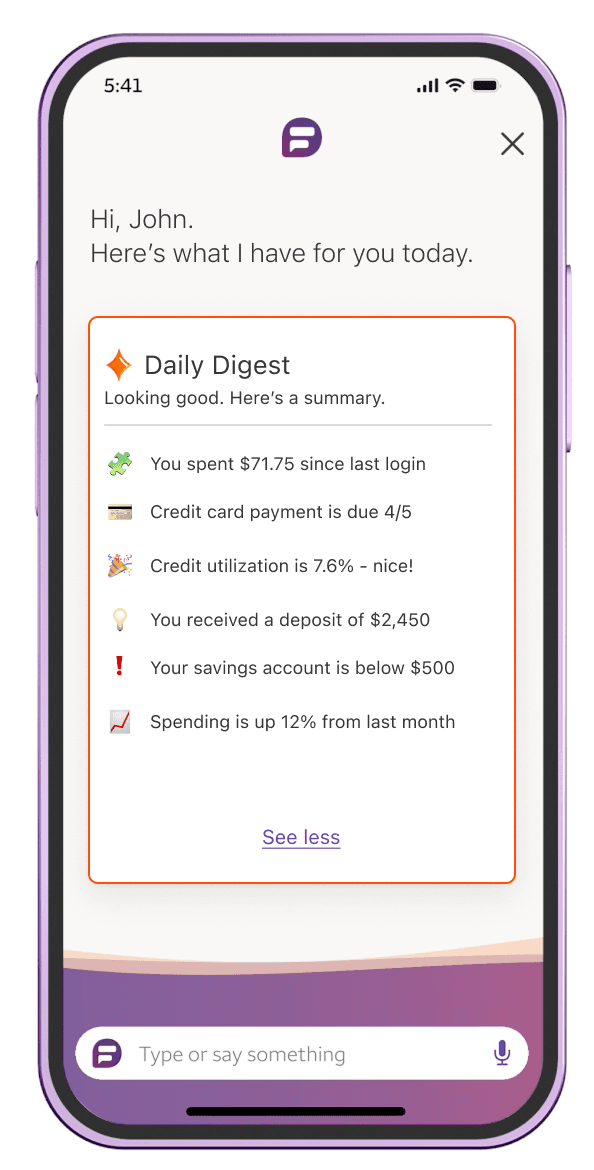
Broader financial picture
Additional insights can be revealed without overwhelming the initial experience.
Project outcome
Establishing a new model for AI-powered guidance.
Daily Digest demonstrated how generative AI could move beyond answering questions to proactively interpreting financial activity on behalf of the customer.
The work established a reusable framework for personalized financial summaries while introducing new approaches for reasoning, prioritization, content curation, and conversational guidance.
As with any AI-powered experience, delivery did not mark the end of the design process. The pilot continues to provide valuable feedback on the quality, relevance, and consistency of the generated content, allowing the team to continuously refine the underlying reasoning, prompts, and prioritization framework as the experience moves toward broader release.
At the time of writing, the experience is being piloted internally with Wells Fargo employees ahead of a broader customer release, so customer engagement metrics are not yet available.
Reflection
Designing how the system thinks.
Daily Digest reinforced that designing AI products extends far beyond the interface. Many of the most meaningful decisions happened upstream—defining how the system interpreted information, prioritized opportunities, and translated complex financial activity into guidance customers could quickly understand.
The project also demonstrated the importance of treating AI behavior as a designed system. Prompt structures, ranking logic, content rules, and interaction patterns all needed to work together to create an experience that felt consistent and useful.
That perspective continues to shape how I approach generative and agentic product experiences today.
Key takeaways
Designed a reusable reasoning framework for AI-generated financial guidance.
Established a methodology for evaluating and prioritizing generative AI content.
Balanced customer value, product goals, and responsible AI behavior.
Delivered the experience through design, implementation, and employee pilot testing.